


Few taxes generate as much confusion and as many complaints as property taxes. Property taxes help fund the essential public services every Mainer depends on — from quality public education, safe communities, and clean drinking water to modern roads, bridges, and other infrastructure. Because property values tend to change more gradually than income or sales, property taxes give communities a relatively stable and predictable way to fund year-round services. Even if taxpayers don’t use every service directly, everyone benefits from living in communities with reliable public services, quality schools, and safe roads.
At the same time, many Mainers feel real pressure from property taxes. Unlike income taxes, property taxes are based on the value of your property, not your direct ability to pay. That means increasing home values or changing local costs can increase tax bills even if your income hasn’t changed.
Here’s a primer on how the system works in Maine and what lawmakers can do to make the system fairer.
Who sets property tax rules?
Both the state of Maine and local governments play important roles.
- The Maine Constitution requires similar types of property to be taxed equally and assessed at fair market value.
- The Maine Legislature sets the basic rules for property taxes, including what property is taxed, which exemptions are available, and how properties are assessed. Maine Revenue Services helps towns and cities follow those rules and provides guidance to local assessors. The state also decides how much money to send to municipalities to help pay for local services. For example, Maine shares 5% of certain tax revenues with towns through revenue sharing, with the money distributed based on a formula that considers factors such as population and need. The state can also require municipalities to provide certain services, such as a baseline level of school funding. Maine’s constitution generally limits the Legislature from requiring new local spending without providing a way to pay for it.
- Cities and towns decide how much money they need to raise each year through their local budgets. In most Maine towns, voters approve school and municipal budgets at town meetings.
- Counties are responsible for law enforcement through the sheriff and district attorney’s offices, as well as courthouses and jails. They also maintain the registries of deeds and probate. These functions are funded through property taxes that towns collect on the county’s behalf. Counties and state agencies provide additional services in unorganized territories. Those residents pay property taxes to the state, which then transfers funding to counties and agencies.
- School districts develop budgets that aim to meet the needs of students in their communities along with obligations set by federal and state law. Some towns fully fund their schools with local property tax dollars and others receive a portion of their budgets from the state. This is determined by a state assessment of a community’s ability to raise revenue to meet a basic level of education services. Some communities roll their school budgets into their town budgets and others, like regional school units, send their budgets to voters separately.
- Local assessors determine the taxable value of each property using state law and assessment standards, but each municipality sets its tax (mill) rate based on its budget needs.
What do property taxes pay for?
Property taxes fund many of the services that make communities work. They help fund:
- Public schools
- Police, fire, and emergency services
- Roads, bridges, and snow plowing
- Water, sewer, and broadband utilities
- Voter registration and elections, licenses, and code enforcement
- Parks, libraries, and recreation
- Waterfront operations, including harbor and dock maintenance, marina management, flood and erosion control, and dam management
- Trash collection, recycling, and waste management
- County services, including courts, jails, and sheriff departments
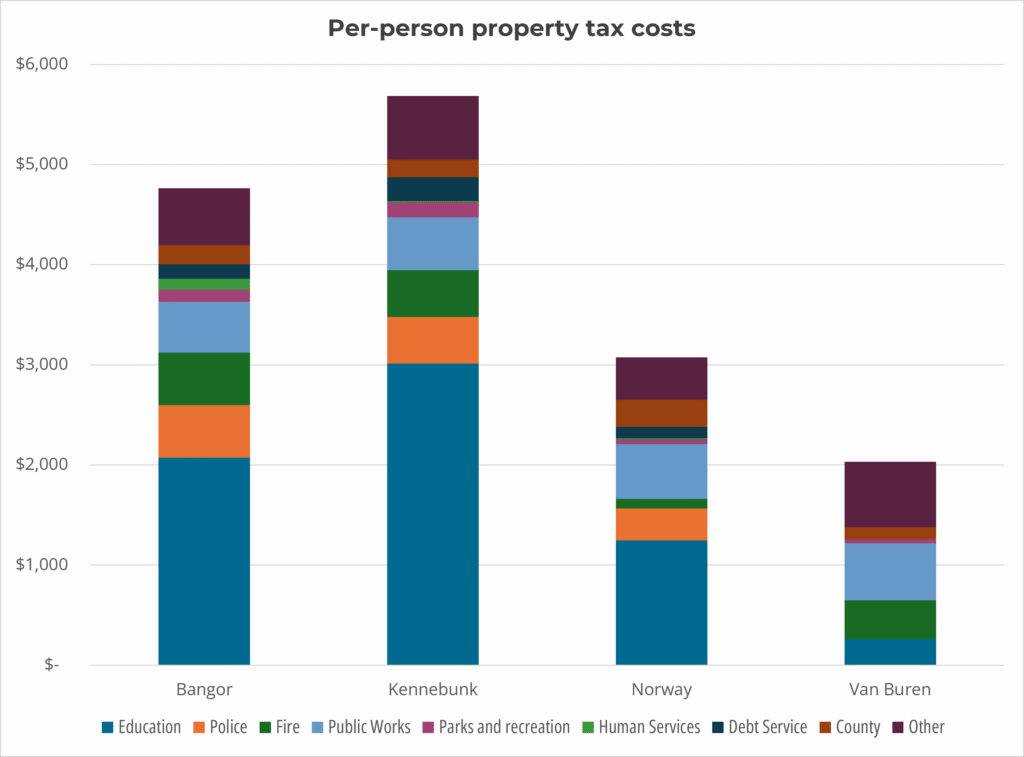
The municipalities were selected to represent a range of population sizes. Population examples include Bangor at approximately 32,000 residents, Kennebunk at 12,000, Norway at 5,000, and Van Buren at 2,000. Kennebunk’s education spending may appear especially high because the town receives relatively little state funding. By contrast, Van Buren’s regional school unit receives about 80% of its funding from the state. Van Buren also eliminated its police department a few years ago. Costs are for the 2026-2027 fiscal year.
What kinds of property are taxed?
Maine municipalities tax real property, including land and buildings. They may also tax personal property, meaning tangible goods located in the state, but in practice this tax applies mostly to business assets such as manufacturing, office, and construction equipment, not ordinary household belongings or personal effects. Most Mainers pay property taxes only on real property. State law exempts household furniture, most individually owned items worth less than $1,000, much farming equipment, and some business equipment that qualifies under the Business Equipment Tax Exemption program.
Intangible assets, such as stocks and shares, are not subject to property taxes in Maine. This creates a disparity between ordinary Mainers, whose wealth is often tied up in their homes, and very wealthy Mainers, who may hold large portfolios of untaxed intangible wealth.
How are property tax bills calculated?
Your property tax bill depends on two things: the value of your property and your town’s tax rate. Property taxes are usually expressed as a “mill rate,” or rate per $1,000 of a property’s assessed value.
For example, if your home is assessed at $300,000 and your town’s mill rate is 15 mills, your annual property tax would be $4,500. If you claim an exemption, such as the homestead exemption, this reduces the taxable value before the mill rate is applied. For a $300,000 home with a $25,000 homestead exemption, the taxable portion would be $275,000, and the tax due at a rate of 15 mills would be $4,125.
Local assessors determine a property’s assessed value based on factors such as:
- Recent sales of similar properties
- The size of the home and land
- Location, such as waterfront property
- Improvements like additions, garages, or finished living space
- Whether the property can be further developed
- Features that reduce value, like conservation easements, wetlands, or certain current-use programs like tree growth or farmland
Your tax bill is based on your property’s assessed value relative to everyone else’s property in your community, not simply what your home is worth on its own.
Are there different rules for different kinds of property?
Generally, no. Maine’s constitution requires property to be taxed equally, so a town cannot tax one neighborhood or type of home at a higher rate than another.
However, state and local governments use several tools to affect how much property tax people pay:
- Property held by federal, tribal, state, or local governments is exempt from local property taxes. Property held by nonprofits, including colleges and hospitals, is also exempt if used primarily for nonprofit, noncommercial purposes.
- Some property is exempt from taxation, including certain business equipment, household furniture, and intangible assets such as stocks and shares.
- Real estate values can be reduced to reflect current uses such as conservation, tree growth, agriculture, or working waterfronts.
- Homeowners can claim a partial homestead exemption on their primary residence, with larger exemptions available for veterans and people who are blind. These exemptions are calculated by each town and reflected in property tax bills sent to homeowners. Homestead exemptions don’t benefit renters, even though renters ultimately help pay property taxes through rent when landlords pass on higher tax costs.
- Homeowners and renters may receive a partial refund against what they paid in property taxes through the state’s Property Tax Fairness Credit claimed when filing income taxes.
Why do property values change?
Under the Maine Constitution, towns must assess property at fair value. Assessors update property values each year, usually making modest adjustments to reflect changes in the local real estate market. Towns and cities also conduct periodic communitywide revaluations, often with the help of a professional firm, to bring property values more fully up to date.
Revaluations can produce larger changes when property values have shifted unevenly across a community. For example, after the COVID-19 pandemic, the value of many homes increased while some business and office properties stagnated. That shift meant homeowners could end up bearing a larger share of the community’s tax load, even if the town’s overall costs had not increased.
State law requires revaluations when a town’s average assessment falls below 70% of market value. Maine’s constitution calls for communities to conduct townwide revaluations at least once every 10 years, although some go much longer. In 2026, for example, Lewiston undertook a revaluation after 38 years without one. The longer a community goes between revaluations, the larger the eventual adjustments may be.
A higher assessment does not automatically mean a higher tax bill. If property values rise across a community, the total value of the tax base increases, and the mill rate can fall accordingly. For example, if a town’s costs stay the same and everyone’s property value rises by the same amount, the mill rate would fall and the amount each property owner pays could stay roughly the same. What matters is how your property’s value changes compared with other properties in your community, not simply whether your assessment went up.
Why do property tax rates vary so much between towns and cities?
Property tax rates reflect both how much a community needs to raise for local services and how much taxable property it has to spread those costs across. Maine’s 480 municipalities have different populations, property values, and service needs, so mill rates vary widely.
For example, Garfield Plantation, with just 79 residents, had Maine’s lowest 2024 mill rate at 0.9 mills. The community provides relatively few public services, so it needs to raise less through property taxes. East Millinocket had the highest rate, at 33.5 mills, after the 2014 closure of the Great Northern Paper Mill caused its taxable property value to fall sharply.
But the mill rate alone doesn’t tell you how much you’ll pay. A town with a low mill rate can still have higher property tax bills than a town with a higher rate if property values are much higher.
Every community has a different mix of property values, population, schools, and other local and county services, as well as different levels of state and federal funding. That’s why two people with similarly valued homes can face very different property tax bills depending on where they live.
For example:
- Communities with very valuable homes may have relatively low mill rates because each mill raises a lot of revenue.
- Communities with lower property values often need higher mill rates to raise enough money to fund schools, roads, and public safety.
- Maine cities have about 15 times more business parcels than tiny towns. Residents of tiny towns shoulder almost all their town’s property tax weight.
- Some communities pay for their own school and public safety services, others consolidate with neighboring towns, and some forgo those services altogether.
- Schools in rural and island communities have much higher per-pupil costs, while urban schools often have large populations of students with diverse educational needs.
- One community might choose to fund new school construction on its own rather than wait years for state funding. Maine only sets aside $150 million every five years for major school construction projects.
What are the primary drivers of property tax increases?
Between 2012 and 2021, property taxes in Maine grew at a consistent rate of about 3%. But between 2022 and 2024, during and after the COVID-19 pandemic, rates accelerated to 7.5% annually. Because income also increased during that time, the share of the typical Mainer’s income spent on property taxes remained between 3.7% to 4.2% over the past decade. But Mainers with low or fixed incomes feel any increases far more acutely.
Property taxes are budget-driven. Rising home values alone do not automatically generate more local revenue unless local spending needs also increase. Some of the biggest drivers of increased local budgets include:
- Increasing costs and more complex services. Municipal services are becoming more expensive to provide, not just because of higher health care, wages, fuel, and materials costs, but also because the work itself is becoming more complex. Communities must respond to and prepare for more severe storms, use modern equipment and technology, maintain complex online systems, operate advanced recycling and waste facilities, fix or replace aging infrastructure, and meet complex environmental requirements. These changes require specialized staff, larger investments in equipment and infrastructure, and higher ongoing construction, operation, and maintenance costs. Among cities nationwide, the majority reported increased infrastructure spending in 2025, with public safety accounting for the largest portion of municipal budgets.
- Changing property values. Statewide, home prices doubled between 2015 and 2025, with most of that increase occurring after 2020. Many coastal Maine towns are still adjusting from a tax base shift from industrial activity to tourism. In Bucksport, where a paper mill closed 10 years ago, property values have risen by more than $270 million in the last five years. In Belfast and Rockland, where art galleries and restaurants have replaced poultry processing, fish canning, and concrete plants, property values have risen 48% and 57% respectively. During and after COVID-19, many of these same communities saw home prices rise higher and commercial property values stagnate, continuing to shift the towns’ tax revenue base from businesses to homeowners.
- Regional service centers bear a bigger share. Hub cities like Portland, Lewiston, Augusta, and Bangor host a disproportionate share of regional services. These communities host universities, hospitals, transportation hubs, and public employers that do not pay property taxes, but which incur infrastructure costs like roads and emergency services the communities pay for. Compared to neighboring municipalities and non-service center cities of similar size, the effective tax rates in these cities are roughly 30% to 40% higher.
- County tax changes. Maine towns don’t only pay for their own municipal services; they’re also billed for county services, including courthouses, jails, sheriff departments, and registries. Driven by rising operational complexity and infrastructure debts, county demands have spiked dramatically. This cost is passed on to property owners through town budgets.
- Federal funding changes. The federal government sends funding to states, counties, and municipalities through federal agencies, earmarks, and grants. These funds help pay for public health, housing, social safety nets, emergencies, and infrastructure projects. While most federal funding goes to state agencies, Maine towns and cities received $888 million in federal funds in FY 2024-2025, most of which came in the form of one-time capital. Federal funding cuts have the greatest impact on the state budget, which can directly impact what state has available to send to municipalities. Cities and primary service centers are also vulnerable. Cutting current recurring federal payments to municipalities would result in a 9% property tax increase in cities and primary service centers to make up the lost revenue.
- State funding changes. When state funding is reduced or fails to keep pace with rising costs, municipalities may have to make up the difference by raising property taxes or reducing services. These changes can reflect gaps in the state budget (including the loss of federal funding) as well as policy choices about state spending. State revenue sharing, for example, is one way the state helps municipalities pay for local services and reduces their reliance on property taxes. Increased state aid can ease property tax pressure, but it does not necessarily result in lower property taxes.
- Population and demographic changes. Older populations often require more public services including EMS response, nutrition, and transportation support, and geriatric training for first responders, while slower population growth can leave fewer taxpayers sharing fixed costs. Similarly, unexpected increases in students with special needs require increased funding for educational supports.
How do property taxes work on Wabanaki land?
Property taxes on Wabanaki land are more complicated than elsewhere in the US because of the 1980 Settlement Acts, which treat the Wabanaki Nations differently than almost every other federally recognized tribe.
Almost everywhere in the US, land held in trust by the federal government for a federally recognized tribal nation is generally not subject to state or local property taxes. That’s because Federal Indian Law grants tribal governments the authority to levy their own taxes and determine how to spend tax revenues. However, under the Settlement Acts, property on tribal land in Maine is not exempt from outside taxation. While the Wabanaki Nations have the right to levy their own property taxes, they are also obligated to make “payments in lieu of taxes” (known as “PILOTS”) equivalent to what external local governments would otherwise collect. Property used primarily for tribal government purposes is exempt from PILOTS in the same way as municipal government property. Property held outside Indian Territory is taxed under the same rules as other property in Maine.
The Wabanaki Nations’ inability to levy and collect property taxes inhibits their ability to fund and strengthen tribal governments and services.
What can be done to relieve property tax pressure?
Rising health care and labor costs, infrastructure needs, changing demographics, uneven property values, county costs, and gaps in state and federal support are all putting pressure on local budgets. Yet the public debate too often reduces this complex challenge to one question: How do we lower property taxes?
The reality is more complex. Property taxes should fairer while raising enough money to pay for public services. Some proposals to achieve that include:
- Provide more state and federal funding for local services. Because state and federal budgets include progressive income taxes, one way to make local property taxes fairer is for the state and federal governments to pay a larger share of costs like public education, county services, and infrastructure.
- Target relief to homeowners and renters by expanding existing programs. The Homestead Exemption reduces the taxable value of an eligible homeowner’s primary residence and is worth proportionally more to homeowners with less valuable homes. The Property Tax Fairness Credit (PTFC) is an even better way to target tax relief because it helps renters as well as homeowners and is directly connected to someone’s ability to pay the property tax. More awareness should be raised about both programs. As many as one in four eligible households may not be claiming their homestead exemption or PTFC.
- Share services across towns. Communities can pool resources for services such as fire, police, emergency response, and public works, spreading costs across multiple municipalities. Maine already does this for schools through regional school units, and similar arrangements can work for other services where communities choose to participate.
- Reform business exemption programs. Maine should periodically review property tax exemptions to make sure they still serve a clear public purpose and do not create large revenue losses for municipalities or shift more costs to homeowners. Lawmakers should require an annual local review of exempt property and set a regular legislative reauthorization schedule for major exemptions, including the Business Equipment Tax Exemption program. Exemptions that are outdated, overly broad, or shifting too much cost onto homeowners and other taxpayers should be narrowed or eliminated.
- Change how different kinds of property are taxed. Amending the state constitution would allow different tax treatment for different kinds of property. For example, taxing very high-value second homes differently than primary residences or taxing commercial property at higher rates than residential property.
- Expand the definition of taxable property. Very wealthy people pay no property tax on intangible assets like stocks and bonds, even though these make up large shares of their wealth.
- Modernize the Settlement Acts to fully recognize tribal sovereignty. The State of Maine should restore the full authority of Wabanaki governments to levy and collect taxes on tribal land. Tribal governments can best decide what services their citizens want and need.
Dive deeper
Tax Fairness — An Explainer | MECEP
Maine Municipal Association Guide to Property Tax
Research and Analysis for the Maine Real Estate Property Tax Relief Task Force
Governors Commission on School Construction – Final Report
Property values are spiking in once-industrial towns on Maine’s coast | Bangor Daily News
How Local Governments Raise Revenue — and What it Means for Tax Equity | ITEP
Anti-Tax Revolts Backfire: What We’ve Learned from 50 Years of Property Tax Limits | ITEP
City Fiscal Conditions 2025 | National League of Cities
The Future of Commercial Real Estate and Big City Budgets | Tax Policy Center