

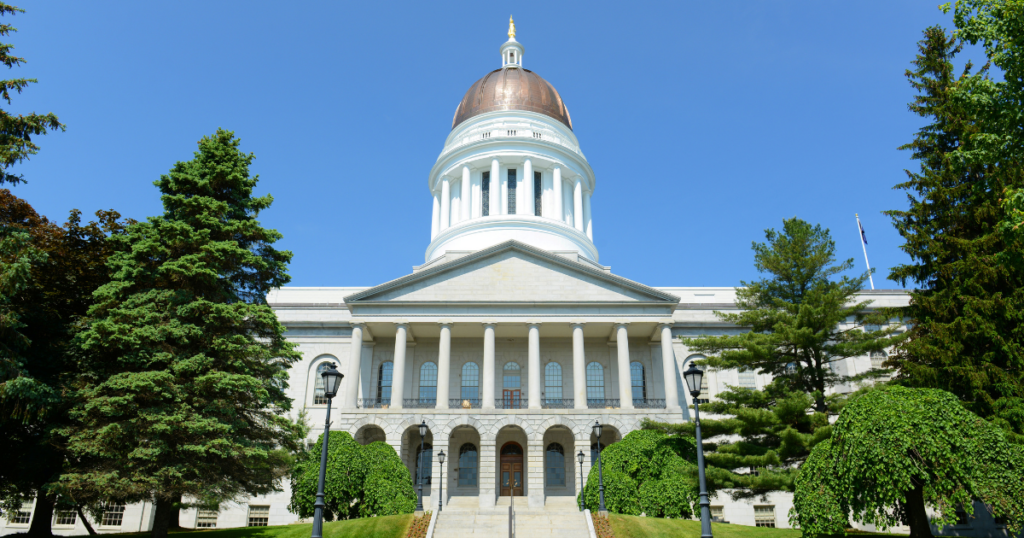
The Appropriations and Financial Affairs Committee (AFA) met Wednesday and recommended passage of a supplemental budget bill that raises taxes on the highest-earning Mainers and draws from the Budget Stabilization Fund to support targeted property tax relief, investments in education, housing, health care and child care, as well as dealing with changes to federal law that impact the tax code and safety net programs.
Tax on high earners
The committee included a new 2% surcharge on incomes over $1 million per year in the budget, based on an existing bill, LD 1089. According to Maine Revenue Services (MRS), this provision would raise just under $96 million in state fiscal year 2027 and approximately $74 million in each year of the next biennium. The tax will begin with the current tax year, 2026 and result in a marginal rate of 9.15% for single individuals with adjusted gross incomes over $1 million and other filers with an adjusted gross income over $1.5 million. MRS reports this would impact just 2,631 tax returns, representing the top 0.4% of filers.
Tax conformity
The supplemental budget would conform with some of the recent individual federal income tax changes in HR 1 — the federal Republican megabill also known as the One Big Beautiful Bill Act — including a small expansion of the standard deduction, which will benefit most middle-income taxpayers. The committee followed the governor’s recommendations to reject gimmicks including partial income tax exemptions for tipped income and overtime pay that were poorly targeted to Mainers who most need help. They also rejected the additional credit for older Mainers, which did not reflect that Maine’s tax code already exempts Social Security and large amounts of retirement income from taxation. AFA also decoupled from the federal deduction for charitable contributions for non-itemizers and car loan interest as recommended by the Taxation Committee.
On the business side, the committee deviated from the governor’s proposal by decoupling the state’s tax code from the Qualified Small Business Stock (QSBS) exemption and went further than the governor suggested in her change package proposal by permanently decoupling from the Opportunity Zones program. Both of these would have given tax breaks to wealthy investors living in Maine for investments made in other states —which are not particularly effective in helping the small businesses and areas with low income they are supposed to benefit. By rejecting the QSBS and Opportunity Zones, the committee retained millions of dollars in tax revenue that can be used to invest in services for Mainers.
The committee did agree with the governor’s recommendations to conform with several other business tax cuts, including increased deductions for loan interest, business assets, and research and development expenses, which will have significant costs, which will grow in future years. The committee followed the governor’s budget by rejecting two high-cost provisions: retroactive application of the changes, and retroactive 100% depreciation deductions on certain business property, machinery, and equipment.
The budget also proposes to conform with several other smaller dollar HR 1 provisions for both individuals and businesses. In total, the cost of conformity in the proposed budget is approximately $48 million in this biennium and $132 million in the next budget cycle.
Outside of conformity questions, the supplemental budget included a significant change with the creation of a new pass-through entity tax, offset by a partial state credit. This will raise $54 million for the state over the next three years but allow the same businesses to avoid millions in federal taxes through what is essentially a tax dodging scheme.
The committee also agreed with a recommendation from the governor to phase out the Business Equipment Tax Reimbursement (BETR) program for retail businesses, since there is little evidence to show these tax breaks incentivize job creation or store openings. The changes to the BETR program will save $3.4 million per year beginning in state fiscal year 2029.
Property tax fairness credit
The committee provided some tax relief to struggling Mainers by expanding the state’s existing Property Tax Fairness Credit. Homeowners under age 65 who have high property taxes or rent relative to their income will now be able to claim up to $1,500 a year in credit, up from the current maximum of $1,000. (Homeowners over age 65 can already claim a maximum credit of $2,000). This will reduce state revenues by approximately $12 million per year on an ongoing basis.
New federal requirements for SNAP and Medicaid
On the spending side, the supplemental budget includes $28 million to meet new federal obligations from HR 1 in the Supplemental Nutrition Assistance Program (SNAP) and MaineCare. These are primarily investments in technology and personnel to administer new work reporting requirements that will do little to get Mainers employed and could lead to tens of thousands losing food assistance and health care coverage. Evidence from other states shows these investments are critical to ensuring Mainers don’t lose help unnecessarily. The federal bill also imposes new penalties on states that make errors in program administration, making it especially important to invest in these eligibility personnel and technology systems.
While this focus on eligibility determination will ensure fewer people lose their benefits due to the federal changes, there is nothing in the supplemental budget to help those who do lose health care or food assistance.
Similarly, even with a reduction in the state’s payment error rate, the new federal law could impose costs of $35-$53 million per year, beginning in October 2027, that are not accounted for in the supplemental budget.
The committee did make some provisions for future federal cuts, authorizing the governor to spend up to $30 million from the Budget Stabilization Fund in the event of an emergency — similar to when the federal government withheld funding for the program during the shutdown last November.
What’s more, the committee transferred $53 million to the MaineCare Stabilization Fund to offset future shortfalls, as well as a portion of any unallocated surplus.
Health care
The supplemental budget would include a rebasing of Maine’s hospital tax to update the amount hospitals contribute based on their 2024 levels. This will raise an additional $24 million a year to pay for health care costs. At the same time, the committee recommended increasing the rates MaineCare pays to hospitals for inpatient services, providing them with an additional $2.5 million in fiscal year 2027 and $5 million a year after that.
The committee also funded a bill to help federally qualified health care centers provide pharmacy services in rural areas that are currently underserved, at a cost of $4 million.
In response to federal threats to family planning providers, the committee proposed replacing $2.2 million in one-time funding HR 1 took away. They also increased the existing state funding for these organizations to $5 million on an ongoing basis and provided contingency language to replace other sources of federal funding that might be eliminated in the future (such as the Title X program). If these happened, the state would have to spend an extra $4.25 million every year.
Care workers
The committee approved investments in the care economy based on bills that were already moving through the legislature including an additional $10 million in ongoing funding for the child care affordability program that helps families with income below 125% of the area’s median income.
Another $10 million in 2027 and $20 million per year in future years was allocated toward a one-time cost-of-living adjustment for certain direct care workers who work with older adults and Mainers with intellectual disabilities, which will increase reimbursement rates to providers by just over 3%.
Housing
The committee included several housing initiatives in the supplemental budget package, primarily funded by one-time draws from the Budget Stabilization Fund. These include:
- $37.5 million for construction of new affordable housing and infill projects in mobile home parks
- $22 million to support homeless shelters across the state
- $11 million to continue the Eviction Prevention Pilot Program, which provides up to $800 a month to keep Mainers in their homes
- $2 million toward aging-in-place programs for older Mainers
Electricity assistance
The supplemental budget would also fund an additional $7.5 million in ongoing costs for the Low-Income Assistance Program that helps Mainers pay for electricity costs, expanding the program’s eligibility.
Meeting ongoing commitments
The committee approved the governor’s requests for additional funding to continue existing MaineCare and K-12 services. This includes $141 million in the Medicaid program to account for rising medical costs and changes in the federal match rate, and $46 million to continue funding 55% of the statewide cost of public education.
Free community college
The committee agreed with the governor’s suggestion to continue a modified version of the free community college program on a permanent basis. Beginning fall of this year, the new version of the program will no longer cover fees for students, which could leave some paying $1,276 per year for the “free” program. The new program also imposes residency requirements and shortens the time for degree completion.
The committee also provided more funding for the community college system to pay for the last students in the existing free community college program.
Public education
The supplemental budget would increase minimum salaries for teachers in the K-12 public system from the current level of $40,000 to $45,000 in the 2027-2028 school year, $47,500 in 2028-2029, and $50,000 in 2029-2030 and beyond. This provision carries no cost in the current biennium but will cost the state approximately $15 million in the next biennium.
The committee also proposed a one-time “bridge payment” of $8 million — targeted at districts based on amount of economically disadvantaged students — to reduce pressure on local property-tax payers.
The committee also funded the governor’s proposal to install safety features on older school buses, at a cost of $5.9 million, as well as her proposal for a statewide ban. Meanwhile $2 million was allocated to continue the “Building Assets, Reducing Risks” program in around 30 schools across the state, and additional money was appropriated to compensate districts with unhoused students.
The committee also assigned $31 million to the Education Stabilization Fund to protect the budget against additional costs in future years.
Affordability checks
The committee modified Governor Mills’ proposal to issue one-time $300 checks to adult Maine residents to help with the rising cost of living, recommending reducing eligibility levels to $50,000 for single tax filers and $100,000 for married couples filing jointly. Eligibility would be based on the income levels in a filer’s 2025 tax return. This cuts the number of people receiving the check by around one third, ensuring relief goes to the people most struggling with inflation. The revised proposal would draw $155 million from the Budget Stabilization Fund, rather than the $218.5 million originally proposed.
Highway fund
The committee proposed a short-term solution to the ongoing shortfall in the highway fund by moving $13 million from the Budget Stabilization Fund for fiscal year 2027 — but it did not endorse a permanent solution such as increasing the gas tax.
Little help for state workers
State workers saw little progress in the supplemental budget, aside from continued funding for some positions hit by federal cuts and the inclusion of some new workers in the state retirement plan. In fact, the supplemental budget keeps the increased attrition rate for state employees approved last year, which removed $68 million from the state employee salary plan. This has left state workers — already underpaid compared to their private-sector counterparts — unable to negotiate higher wages with the Mills administration.
Conclusion
The supplemental budget makes a big step forward in tax fairness through the creation of a “millionaire tax” that allows lawmakers to make important investments for Mainers while meeting new federal costs and anticipating future cuts.
The supplemental budget would withdraw $291 million from the Budget Stabilization Fund, slightly less than the $320 million proposed by the governor. This will still leave more than $700 million in the fund to offset a revenue shortfall in case of a recession.
On the other hand, significant unmet needs remain, particularly closing the pay gap for state workers. There was no provision for continuing health care or food assistance for Mainers who will be excluded by new and expanded work reporting requirements. Finally, the size of the budget gap facing lawmakers next year is uncertain, given the potential for new state costs for SNAP, continued issues with the highway fund, and the creation of new ongoing commitments for the state.